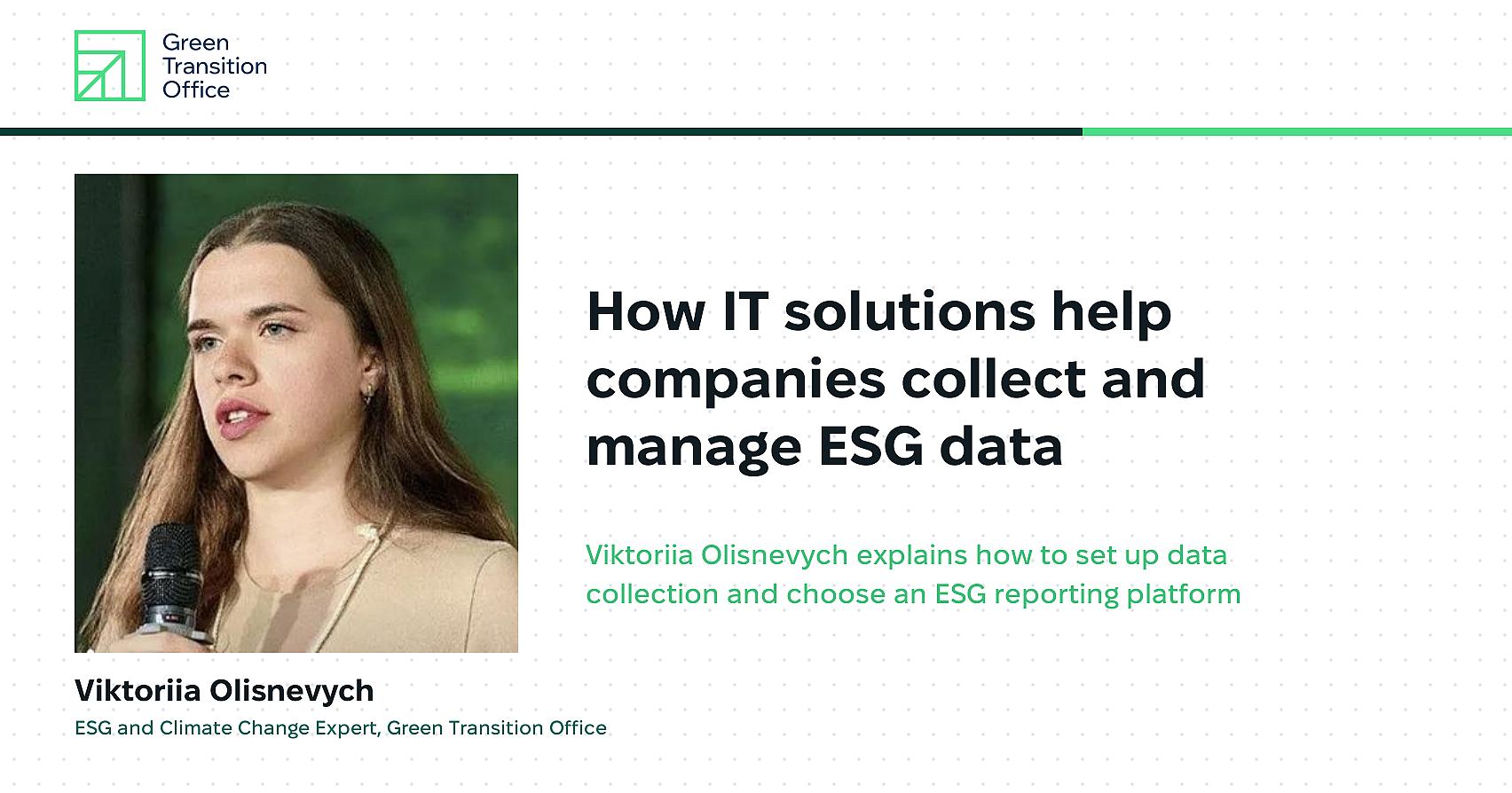
How IT solutions help companies collect and manage ESG data
Companies use ESG data to assess risks, make management decisions, prepare reports and answer requests from clients and investors. This information comes from different departments and systems, so collecting, checking and reconciling it often takes considerable resources. Specialised IT solutions help automate these processes, improve data quality and make every indicator traceable from the original record to the final report.
Data for ESG reporting comes from accounting and HR systems, procurement portals and specialist departments, so different teams may interpret the same indicator differently or report it in different units. When responsibilities are not clearly assigned, it is hard to tell who should fix an error.
During the online meeting “ESG for IT Companies”, organised by the Green Transition Office, KSE Business School and Diia.City Union, Viktoriia Olisnevych, ESG and Climate Change Expert at the Green Transition Office, explained how to build a system that links every figure in a report back to its original record. The first step is to set a definition, source, units of measurement and responsible people for each indicator. The indicator owner decides on the calculation methodology, while the data steward organises data collection and checks that the data is correct.
The system logs every change and approval in an audit trail, keeping the previous and new value, the author and the date of the change, so the way an indicator was built can be fully reconstructed. A source document such as an invoice or a meter reading can be attached to the record, and the platform checks required fields, units of measurement and duplicates automatically.
According to a 2024 KPMG survey, 90% of department heads planned to increase ESG investment over the next three years, with specialised software among their priorities. Verdantix counts more than 100 solutions on the market for ESG data management and reporting alone, and the selection criteria Viktoriia Olisnevych outlined describe what a competitive product needs to offer. Such a platform should pull data from the company’s accounting and HR systems, detect gaps and duplicates, show calculation formulas and factors, and keep the change history along with supporting documents.
She advises choosing a solution only after the company has decided which data it will collect and which systems that data will come from. A platform can also be tested in practice on a single indicator, such as electricity consumption, by asking the vendor to walk through the whole process of entering, checking and approving it.
According to IBM, automation has helped Growthpoint cut the time it spends on ESG disclosure and reporting by 50%. Results depend on the size of a company and how its data is organised, so the effect is best measured by comparing how long reporting takes and how many corrections are needed before and after the software is introduced.
The meeting recording is available at https://www.youtube.com/watch?v=bSmtu3RsZeg, and the speakers’ presentations can be downloaded here https://drive.google.com/drive/folders/1GzV4MyRc8g2xab8L-PgTCb1W2Rz8MXyn?usp=sharing
Published on