The European Commission’s assessment of CBAM’s impact on Ukraine no longer matches reality
Andrii Kitura, Head of the Green Transition Office
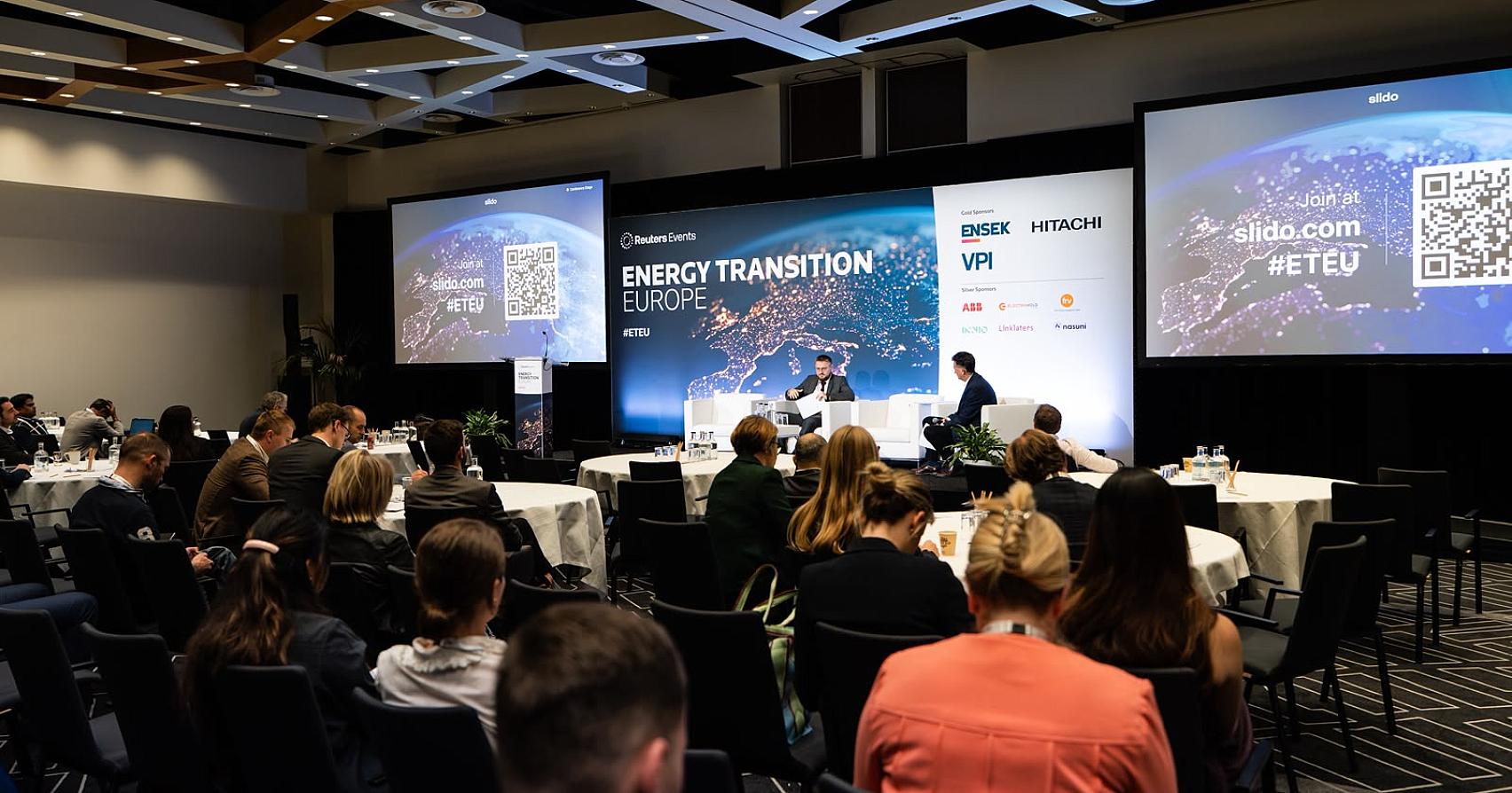
The Carbon Border Adjustment Mechanism rests on a simple principle that a tonne of goods or a kilowatt-hour of power arriving at the EU border should carry the same greenhouse gas emissions cost that a European producer has already paid. European businesses have been paying for their emissions for more than twenty years, and as heavy industry gradually loses its free allowances between 2026 and 2034, production could simply move abroad, taking its emissions with it, unless such a tool is in place. As a candidate country, Ukraine fully shares the goals and substance of EU climate policy, CBAM included. The Ukrainian government is preparing its own emissions trading system and wants to become part of the European carbon market. That is why, speaking on a CBAM panel at Reuters Energy Transition Europe 2026 in Amsterdam, I focused on how these rules work for countries exporting to the EU, and for Ukraine in particular as a country facing unprovoked military aggression.
In December 2025, as part of its latest regulatory package, the European Commission carried out a separate analysis of CBAM’s impact on Ukraine. While it acknowledged that Ukraine exports substantial volumes of CBAM goods to the EU, worth €3.3 billion or 1.8% of Ukrainian GDP, it relied on a model projecting an impact on the Ukrainian economy of just 0.01% of GDP by 2035 and concluded that there was no significant impact “at this stage”. The analysis also drew on data from the transitional period, when importers paid nothing. The reports filed by importers of Ukrainian goods at the time showed only that companies had learned to fill in the forms, and could reveal nothing about how buyers would behave once every tonne of emissions carried a price. The Commission itself admits that its model does not fully capture the damage the war has done to our industry. I would also point out that the Commission based its estimates on the JRC-GEM-E3 computable general equilibrium (CGE) model, which draws on the GTAP 11 dataset with 2017 as its reference year.
In the first quarter of 2026, Ukraine’s metals exports fell by at least 17%, with some products down by as much as 93%. ArcelorMittal Kryvyi Rih, whose European customers cancelled around 300,000 tonnes of orders, stopped supplying the EU altogether, and over nine months Ukrainian steel exports dropped by 22%. Turkey managed to redirect its sales to the UK and Egypt, but that route is far harder for Ukrainian producers, since 82% of our steel exports go to the EU and our ports and railways are under constant attack. Part of the decline in exports is down to missile strikes that have left Zaporizhstal idle and brought Kametstal to a standstill. That is the heart of the problem, because CBAM is hitting an industry already fighting for survival, and a model that leaves the war out cannot gauge its cumulative effect.
In my view, what is needed is a separate, transparent assessment built on actual product-level data, with emissions calculated per tonne of output, as the Commission has already done for Mozambique, and the cost per tonne set out for every year up to 2034, taking into account the wartime conditions that complicate verification, energy supply and logistics. It would also make sense to use more recent statistics for the modelling, since a great deal has changed since 2017. While that assessment is under way, practical solutions such as remote verification should be put in place. In its position of 15 September, the European Parliament already allowed for temporary measures for countries in a state of protracted war, and it is important that the Council and the Commission keep this provision in the final text, on which the parties hope to reach agreement by the end of November.
In its first year of operation, CBAM rewards those who can prove their emissions, which makes data a condition of market access. Ukraine’s major steelmakers already submit actual data for most of their volumes, but verifying the reports of a plant that could be hit by a missile on any given day is far harder than auditing a facility inside the EU. If CBAM is to drive genuine decarbonisation, verification has to be within reach of every producer, whatever its resources.
CBAM rules also have a significant bearing on electricity exports. Nuclear plants generate around half of Ukraine’s electricity, and at times as much as two thirds, while hydro and other renewables account for roughly another 20 to 25%. Yet the default value for Ukraine is 0.9 tonnes of CO2 per megawatt-hour, as though all of it came from fossil fuels, namely coal. As a result, every megawatt-hour exported to the EU becomes roughly €75 more expensive, which is about two thirds of the wholesale price in neighbouring EU countries.
Ukraine currently imports more electricity than it exports because Russia keeps striking our power plants, but nuclear, hydro and renewable generation, together with a rapidly growing fleet of storage, will allow us to supply clean and flexible power once again. In spring 2026 the Verkhovna Rada passed a law on integration with the European electricity market, and the regulation already provides an exemption for countries that couple their markets and introduce an equivalent carbon price, so the next step is to set out in a memorandum, as the Commission proposes, a realistic date by which Ukraine will be able to use it. We also need emission factors calculated on the basis of the entire energy mix, along with an exemption for the emergency flows that keep the grid stable, something Poland, Estonia and Lithuania have already asked for.
Ukraine, for its part, must pass a law on an emissions trading system and build its own verification capacity while sharing data openly. In the long run, CBAM could become a bridge that brings the EU’s neighbours closer to its carbon market.
The Green Transition Office is an independent advisory body under the Ministry of Economy, Environment and Agriculture of Ukraine that helps to implement reforms in the field of green transition, energy and climate policy of Ukraine. The Green Transition Office operates with the financial support of the UK Agency for International Development and is implemented by DiXi Group.
Published on