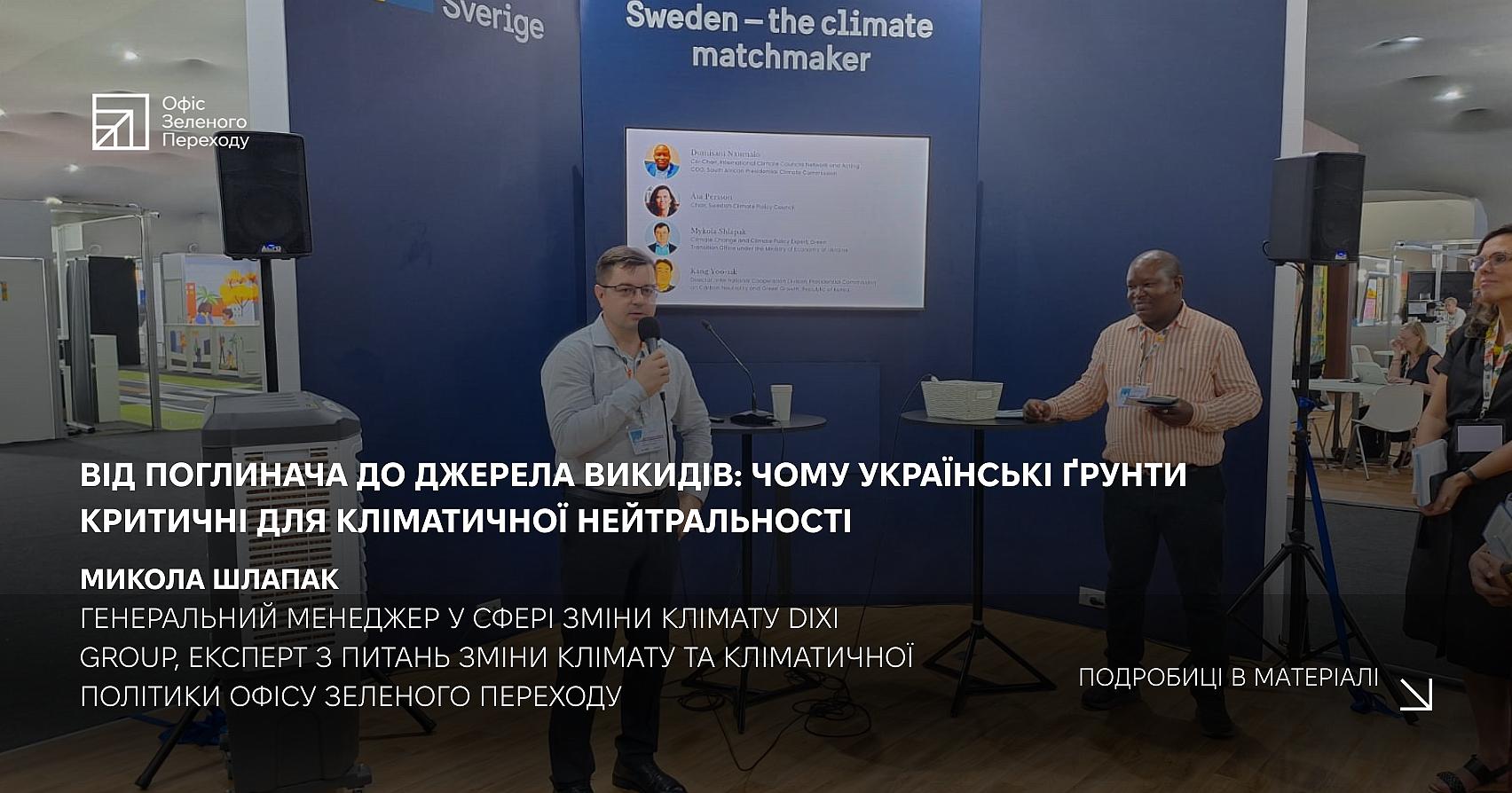
From a Carbon Sink to an Emission Source: Why Ukrainian Soils Are Critical for Climate Neutrality
On November 13, 2025, at COP30 in Belém, the International Network of Climate Councils (ICCN) presented the report "Harvesting Solutions: Real-World Policy to Transform Food, Land and Agriculture". Among the participants of the event at the Swedish Pavilion was Mykola Shlapak, climate policy expert at the Green Transition Office, who presented a sectoral decarbonization report for the Agriculture sector in Ukraine.
The event brought together representatives of climate councils from different countries, including Sweden, South Africa, and the Republic of Korea, to exchange practical examples of policies and measures in the food and agricultural sector.
Agriculture is a key sector of Ukrainian economy and a major source of GHG emissions, contributing about one quarter of national emissions. The Green Transition Office team looked at the agriculture sector in a broad context and analyzed emissions from crop production, livestock production, unsustainable land use, land use change, as well as emissions from fuel and energy consumption by agricultural enterprises.
Combined these sources generated 76 million tonnes of CO2e of greenhouse gas emissions in 2021 accounting for about 23% of Ukraine's total emissions. In 2022, due to the impact of war and the economic downturn, emissions dropped to 57 million tonnes of CO2e, but their share increased to 26%.
The expert emphasized the critically important role of the sector in achieving national climate goals. He noted that over the last decades Ukrainian soils switched from being natural carbon sinks to a significant source of emissions due to soil organic carbon loss. The success in achieving the climate neutrality target will depend significantly on whether this trend could be reversed.
Speaking about the challenges of achieving the climate neutrality target by 2050, Mykola Shlapak emphasized: "If soils will remain a source of additional residual emissions due to soil organic carbon loss the climate neutrality target could be out of reach. At the same time, if agricultural soils are converted back to being carbon sinks together with carbon sequestration by forests this could enable the achievement of climate neutrality, offsetting residual emissions from other sectors."
The speaker noted that despite this significant role in achieving climate neutrality, climate mitigation is not sufficiently embedded in agricultural policy. The main purpose of the study was to highlight the role of agriculture in achieving climate goals and assess cost-effectiveness of different decarbonization options.
The study developed by the Green Transition Office team includes an analysis of emission drivers and 22 technologies offering a total annual mitigation potential of 39 Mt of CO2e. The largest potential impact comes from using crop residues and other products for biogas, power and heat, as well as cover cropping and application of carbon-rich soil amendments. The analysis focused on cost-effectiveness, as national priorities alongside climate goals emphasise economic recovery and food security.
The study informed expert discussions on Ukraine's second NDC highlighting the agricultural sector's role in enabling residual emissions for other sectors by preventing soil organic carbon loss and enhancing carbon sequestration. Besides, the findings of the study were used in developing policies and measures for the National Energy and Climate Plan development of the updated version of which is expected later this year.
The Green Transition Office is an independent advisory body under the Ministry of Economy, Environment and Agriculture of Ukraine that helps to implement reforms in the field of green transition, energy and climate policy of Ukraine. The Green Transition Office operates with the financial support of the UK Agency for International Development and is implemented by DiXi Group.
Published on