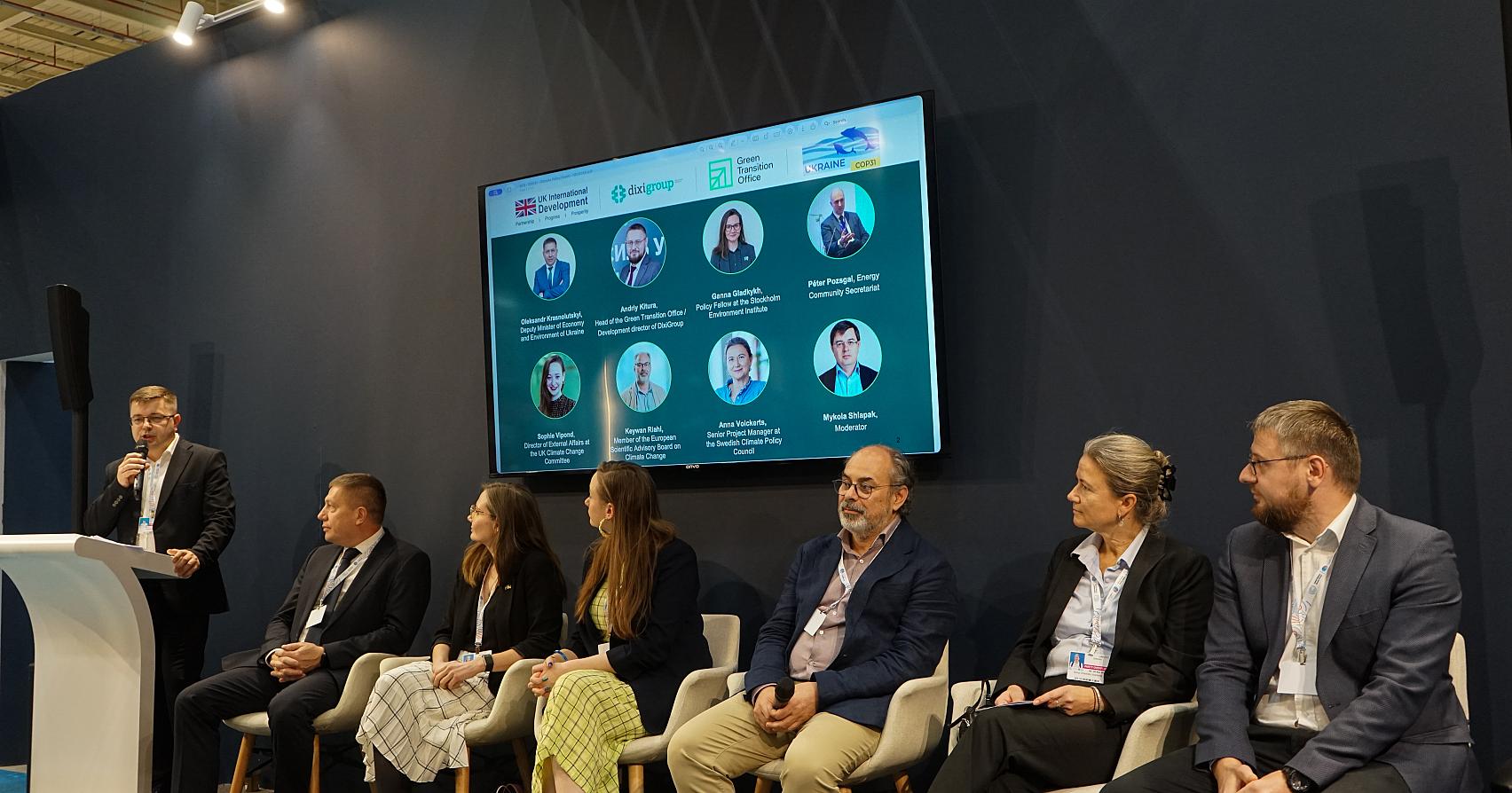
From climate targets to implementation: international experts discuss effective climate governance at the Ukraine Pavilion at COP31
Representatives of the Ukrainian Government, international organisations, research institutions, and independent climate advisory bodies gathered at the Ukraine Pavilion to discuss how to strengthen climate policy implementation, improve progress monitoring, and use science-based evidence to inform policy and investment decisions. The discussion took place on 10 November 2026 as part of a panel titled “How to Move from Climate Targets to Implementation: International Experience in Climate Policy Planning, Monitoring and Assessment” organised by the Green Transition Office.
The discussion was moderated by Mykola Shlapak, Climate Change and Climate Policy Expert at the Green Transition Office. He began by pointing out that Ukraine has already enshrined the goal of achieving climate neutrality by 2050 in national legislation, updated its National Energy and Climate Plan (NECP), and continued working to integrate climate considerations into sectoral policies and investment planning. However, translating these commitments into effective policies and measures, supported by reliable monitoring, reporting and assessment mechanisms, remains a key challenge.
Despite the ongoing war, strengthening climate governance is essential for Ukraine's EU integration, green recovery, and access to climate finance.
During the panel, participants explored the key elements of an effective climate governance framework, including monitoring and reporting on climate policy implementation, modelling future decarbonisation pathways, independently assessing progress towards climate targets, and ensuring transparent communication of results to policymakers and other stakeholders.
Oleksandr Krasnolutskyi, Deputy Minister of Economy and Environment of Ukraine, addressed Ukraine's progress in establishing and implementing its climate policy framework. The discussion covered the importance of maintaining climate policy priorities despite the challenges of the war, as well as the role of effective climate governance in advancing EU integration and attracting investment for green recovery.
“Ukraine has been consistently working to strengthen national climate policy in line with EU accession requirements and international commitments. In 2026 alone, Ukraine has adopted the updated National Energy and Climate Plan, the Long-term Low-Emissions Development Strategy, and developed a draft law on the national emissions trading system. Ukraine not only adopts strategic documents and framework legislation but also works on practical implementation of climate policy and mobilising climate finance. In particular, we have recently adopted a regulation on monitoring and assessment of state climate policy and launched a pilot initiative on implementation of Article 6 projects under the Paris Agreement”, – commented Oleksandr Krasnolutskyi, Deputy Minister of Economy and Environment of Ukraine, during his opening remarks.
He also stressed that the emissions trading scheme will have to be introduced gradually, with a transition period and clear milestones for each stage, as the decarbonisation of industry takes time and requires significant investment.
Andriy Kitura, Head of the Green Transition Office (GTO) and Development Director of DiXi Group, discussed GTO's role in supporting the Government of Ukraine and, in particular, the Ministry of Economy and Environment, in implementing climate policy and developing tools for effective monitoring and long-term decarbonisation planning. The discussion highlighted analytical work on the decarbonisation potential of key sectors of Ukraine's economy, GTO’s contribution to monitoring NECP implementation, and the approach to developing a national carbon budget, which can translate long-term climate targets into measurable emissions trajectories.
“Having a single number as a climate target is not sufficient. It gives an indication of the desired destination point but does not give a route to get there. It is important to have a very concrete plan for key carbon-intensive industries and sectors with respect to future emissions pathways. We are working on sectoral decarbonization studies that will be aligned with the requirements of the Ukrainian Climate Law and will include information on the potential emission reductions and cost-effectiveness of mitigation action. The aim is to connect national targets, sectoral decarbonization pathways and specific investment projects”, – commented Andriy Kitura.
The panel also addressed Ukraine's first experience with reporting on the implementation of the National Energy and Climate Plan. In 2025, the Energy Community conducted its first reporting cycle on the implementation of national energy and climate plans and Ukraine was the only Contracting Party to submit its report on time. This example was presented by Péter Pozsgai, representing the Energy Community Secretariat, while discussing lessons from Ukraine's initial NECP implementation reporting and the importance of establishing an effective monitoring and reporting system. Particular attention was given to how regular progress reviews can help identify policy gaps, inform corrective measures, and support future climate policy decisions.
“Ukraine is an excellent example of sustained and consistent efforts to prepare the NECP and establish a comprehensive monitoring and reporting framework that integrates and aligns different reporting practices in the energy and climate sectors”, – noted Péter Pozsgai.
Another important topic was the role of science-based modelling and scenario analysis in identifying credible pathways towards climate neutrality.
Ganna Gladkykh, Policy Fellow at the Stockholm Environment Institute (SEI), discussed how scientific modelling can support Ukraine in assessing future decarbonisation pathways, identifying investment priorities, and developing sectoral decarbonisation roadmaps. SEI works with GTO on developing sectoral decarbonization roadmaps and building modelling capacity using Low Emissions Analysis Platform (LEAP) software – a widely used software tool for energy policy analysis and climate change mitigation assessment developed at the Stockholm Environment Institute.
The discussion also drew on international experience in independent climate policy assessment and government accountability.
Sophie Vipond, Director of External Affairs at the UK Climate Change Committee, shared the United Kingdom's experience with carbon budgets, annual independent progress assessments, and evidence-based recommendations to the Government. The discussion highlighted the role of independent climate advisory bodies in evaluating whether existing policies are sufficient to meet climate targets and identifying areas requiring additional action.
Keywan Riahi, Member of the European Scientific Advisory Board on Climate Change, addressed the role of scientific evidence and indicators in evaluating progress towards EU climate targets.
The discussion explored how independent scientific assessments can identify gaps between climate ambitions and policy implementation, providing a stronger evidence base for future policy decisions.
Anna Volckerts, Senior Project Manager at the Swedish Climate Policy Council, shared Sweden's experience with making climate policy information and progress assessments more accessible through the Panorama platform. The discussion highlighted the importance of transparent data, accessible monitoring tools, and effective communication in helping policymakers, businesses, and other stakeholders understand the pace and direction of the climate transition.
A central theme of the discussion was the need to establish an integrated climate governance framework in which policy implementation monitoring, science-based modelling, independent progress assessment, and transparent communication work together. Such an approach can help policymakers understand whether current measures are sufficient to achieve climate targets, identify implementation gaps, introduce corrective actions, and align long-term planning with investment priorities.
The discussion provided an opportunity to exchange international experience and consider how Ukraine can further strengthen the institutional, analytical, and monitoring foundations needed to translate climate commitments into effective policies, measurable results, and investment opportunities.
At the end of the discussion, Mykola Shlapak invited each speaker to identify the single most important step Ukraine should take over the next 12 months to strengthen its climate governance framework.
Péter Pozsgai recommended finalising the adoption of the law on the emissions trading system, continuing the implementation of greenhouse gas emissions monitoring and verification at the installation level, and starting the development of the National Energy and Climate Plan (NECP) for 2030–2040. Andriy Kitura also identified the adoption of the law on the emissions trading system as the most important and challenging next step, stressing that it was time to conclude the longstanding discussions within Ukraine and with the EU and adopt the legislation. Keywan Riahi agreed that an emissions trading system would improve the effectiveness of climate policy. Sophie Vipond advised Ukraine to continue improving its NECP while implementing it, recalling the British expression about building a plane while flying it. Ganna Gladkykh called for linking new strategies with investment projects from the outset and systematically developing the skills that Ukraine’s economy will need in the coming decades.
In his closing remarks, Mykola Shlapak stated that the Green Transition Office would take all the recommendations into account and use them in its work supporting the Government in building an integrated climate governance framework. He also committed to reporting on progress at COP32 next year.
We thank all the speakers for the insightful discussion, as well as our partners and participants who joined us at the Pavilion and online for their interest in Ukraine’s climate policy.
Recording: https://www.youtube.com/live/LmwQvQCTleo
The Green Transition Office is an independent advisory body under the Ministry of Economy and Environment of Ukraine that helps to implement reforms in the field of green transition, energy and climate policy of Ukraine. The Green Transition Office operates with the financial support of the UK International Development and is implemented by Dixi Group.
Photo credit - Diana Popfalushi
Published on