In the EU, obligation schemes account for over a third of energy savings. In Ukraine, the instrument is still waiting to be introduced
Energy efficiency obligation schemes, a market mechanism that requires energy companies to help their clients save energy, accounted for over a third of all energy savings in the EU between 2014 and 2020. The Green Transition Office has dedicated a new study to this instrument: "Energy Efficiency Obligation Schemes in the EU: Policy Design and Best Practices." In Ukraine, legislation permits the introduction of such a mechanism, but it is not yet in operation.
The study's author, Valentyna Huch, Energy and Climate Expert at the Green Transition Office at the Ministry of Economy, Environment and Agriculture of Ukraine, explains the instrument in straightforward terms.
"In simple terms, an obligation scheme is when the government requires energy companies to implement energy efficiency measures for their customers. It sounds counterintuitive: the party selling energy is supposed to help save it. But this instrument has already proved its effectiveness in 13 EU member states. For energy efficiency policy, it is the logical next step. Perhaps not this year, but next — this is our future, and it is already close," she said.
The approach comes down to a simple insight: energy suppliers have direct contact with end consumers and know their actual consumption patterns. This puts them in a better position to identify savings potential than the state could on its own.
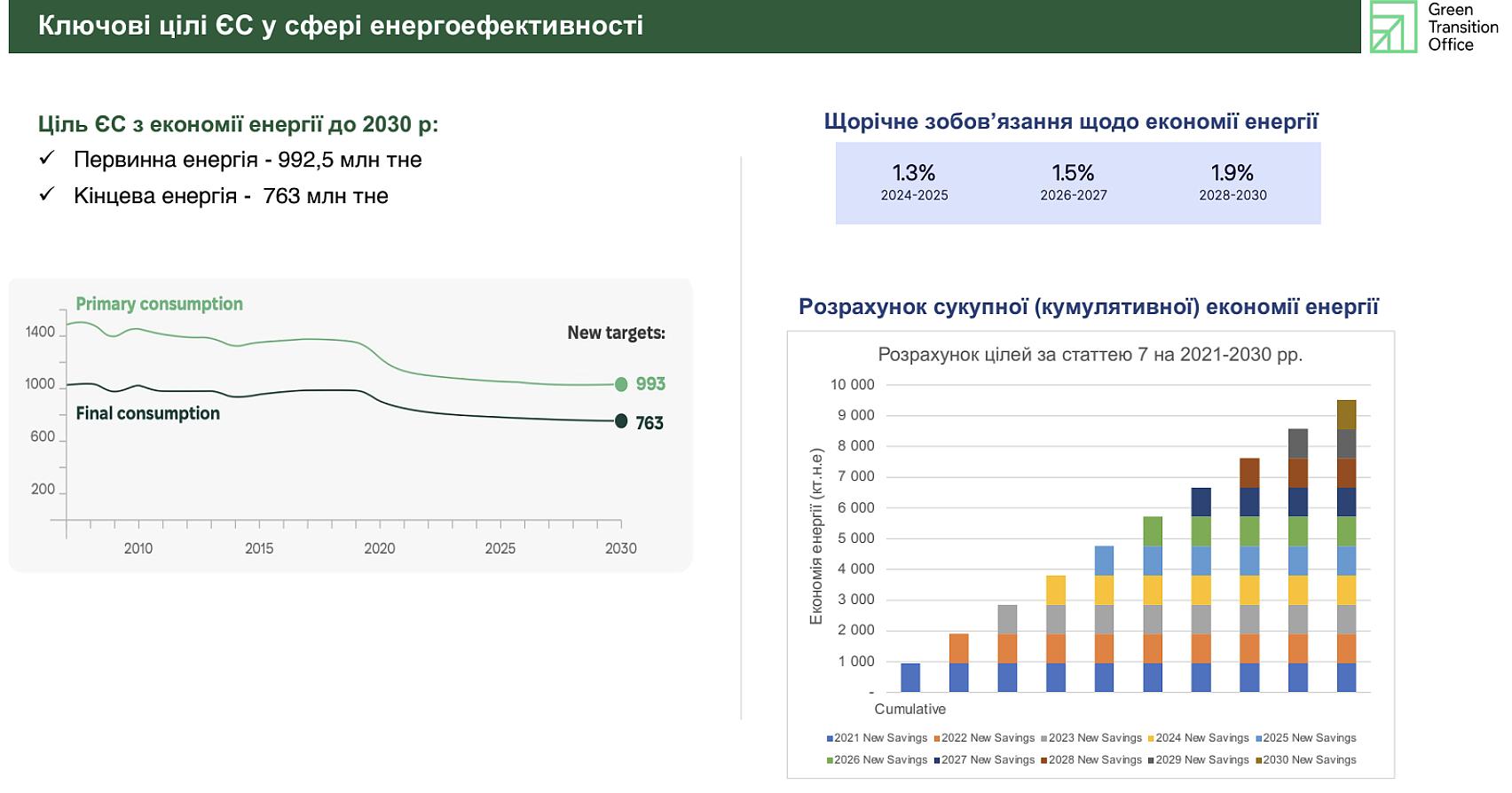
Ukraine's Law on Energy Efficiency allows for the introduction of such a mechanism if there is a risk of failing to meet the cumulative energy savings target. Progress toward that target has so far been slow. The Energy Efficiency Fund, which has remained the primary state instrument, has delivered less than one percent of the savings volume planned through 2030.
As part of the study, the team examined the experience of four EU countries, each of which chose a different model.
The longest track record belongs to the French system of energy savings certificates, launched in 2006. Over nearly two decades, the CEE market has attracted more than 4 billion euros in private investment annually and is considered one of the most mature in Europe.
A similar white certificate trading market developed in Italy, where energy service companies play an active role and the primary focus is on the industrial sector.
Poland's experience serves largely as a cautionary example. The local mechanism includes a so-called substitution payment, which allows energy companies to contribute to a dedicated fund rather than actually implementing savings measures. This weakens the incentive for real results and creates market dependence on a single fund monopolist.
The British model differs most from the three examples above. The ECO scheme focuses not on market-based certificate trading but on direct support for energy-vulnerable households, with energy companies directly financing insulation or heating equipment replacement.
The study also sets out a starting point for building such an instrument in Ukraine. The first step involves identifying obligated parties, that is, the companies that will bear responsibility for delivering energy savings. Decisions must also be made on how savings will be measured and who will administer the system. Without this, obligations will remain declarations on paper.
The full text of "Energy Efficiency Obligation Schemes in the EU: Policy Design and Best Practices" and Valentyna Huch's presentation are available in Ukrainian on the Green Transition Office website.
Study: https://gto.dixigroup.org/assets/images/files/gto-skhemy-zoboviazan-z-enerhoefektyvnosti-a4.pdf
Presentation: https://drive.google.com/file/d/1OQfVHSpF6oGCs4kmtQHX0AFiFE0D6EcX/view?usp=sharing
Published on