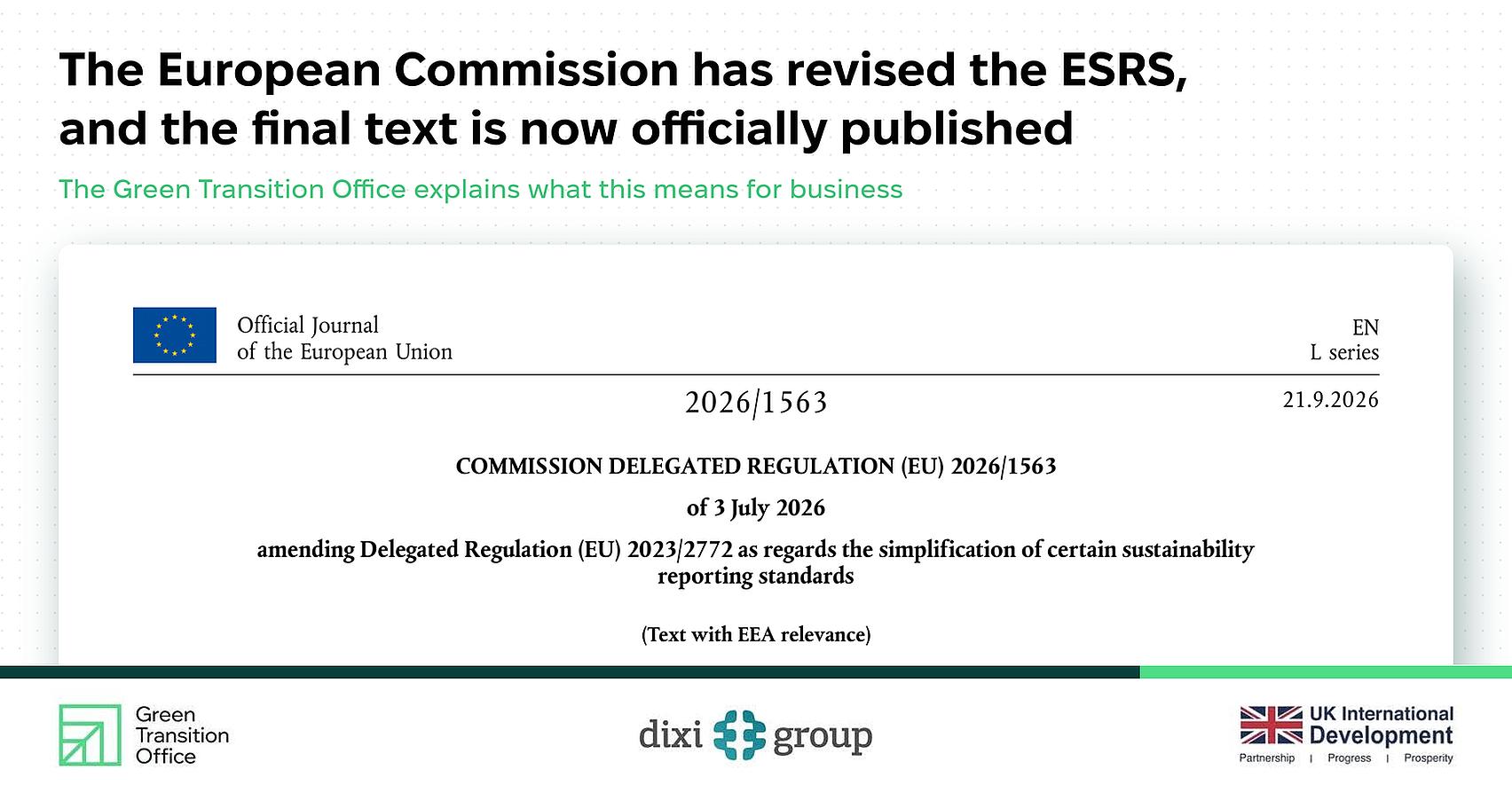
Revised ESRS officially published in the Official Journal of the EU
The final legal text of the revised European Sustainability Reporting Standards (ESRS) was published in the Official Journal of the EU on 21 September 2026, alongside a voluntary sustainability reporting standard for undertakings outside the scope of the Corporate Sustainability Reporting Directive (CSRD). The two Commission Delegated Regulations complete the Omnibus I simplification package for corporate sustainability reporting.
After months of drafts, proposals and near-final texts in circulation, this is now the only legally binding version, and companies and their advisers should check their approach against it.
Commission Delegated Regulation (EU) 2026/1563 replaces the current ESRS with a revised, simplified set. It enters into force on 10 November 2026 and applies to financial years beginning on or after 1 January 2027, with the first reports due in 2028. The revised standards cut the number of datapoints and prioritise quantitative datapoints over narrative text. Mandatory and voluntary datapoints are now more clearly distinguished, and the standards give clearer instructions on how to apply the materiality principle. They are also more consistent with other EU legislation and take account, as far as possible, of interoperability with global reporting standards.
For financial year 2026, undertakings within the scope of the CSRD may use the existing ESRS, the existing ESRS supplemented by certain reliefs from the new Delegated Regulation, or the Revised ESRS in full. The reliefs cover, among other things, the top-down materiality approach, the value chain limitation, new acquisitions and disposals, Taxonomy presentation and the executive summary. The sustainability statement must make clear which version has been applied.
The voluntary standard is established by Commission Delegated Regulation (EU) 2026/1560. It enters into force on 24 September 2026 and is available to any undertaking not subject to mandatory reporting under the CSRD. The regulation also introduces a value chain cap. From financial years beginning on or after 1 January 2027, undertakings subject to mandatory sustainability reporting will not be able to ask value chain partners with an average of 1,000 employees or fewer for information beyond the short list of essential environmental, social and governance datapoints in Annex II. The cap only covers information gathered for the requester's own CSRD reporting and does not limit requests needed to meet other EU or national legal obligations.
"This is an important change for Ukraine, as we are effectively building a national sustainability reporting system in parallel with regulatory changes within the EU itself," says Oleksiy Yatsyuk, ESG Expert at the Green Transition Office. He points out that "according to the Green Transition Office's research, regulatory uncertainty is one of the three main barriers Ukrainian businesses see to implementing ESG in practice. So the publication of the final simplified version of the ESRS, whose requirements are to be integrated into Ukrainian legislation as well, brings much-needed clarity."
"Ukrainian companies now have a better sense of which requirements to prepare for and how to set up their ESG data collection and reporting processes," he adds. "And this matters not only for companies that will be subject to mandatory reporting in the future. ESG data is increasingly needed right now to work with European partners, banks and investors."
For companies getting ready for the new requirements, the Green Transition Office has published several studies. CSRD in Ukraine: Key Points for Business looks at where the directive sits within the European Green Deal, reviews the ESRS and covers data digitalisation requirements. ESG Reporting: Analysis of Disclosure Practices examines how companies disclose information under the CSRD, ESRS and EU Taxonomy and how this reporting is audited. SMEs can find practical recommendations in the Office's guide to reporting under the VSME.
The Green Transition Office is an independent advisory body under the Ministry of Economy of Ukraine that helps to implement reforms in the field of green transition, energy and climate policy of Ukraine. The Green Transition Office operates with the financial support of the UK International Development and is implemented by Dixi Group.
Published on