Ukraine's Green Transition Office and KSE Graduate Business School Launch Program for ESG Professionals
Ukrainian businesses face a paradoxical challenge: building systems during wartime that will determine competitiveness after it. ESG is no longer optional for companies planning to remain in the market – it's now a matter of survival, access to capital, and the ability to retain qualified personnel. This is especially true for businesses oriented toward European markets. As part of discussions on amendments to the CSRD directive, the European Parliament plans to set updated mandatory reporting thresholds for companies with over 1,000 employees and turnover exceeding €450 million, while Ukraine is adapting these directives within the framework of the government Strategy.
Most Ukrainian companies are already prepared for change and recognize the importance of ESG. However, in practice, the key barrier is not lack of motivation, but a shortage of people capable of implementing these changes.
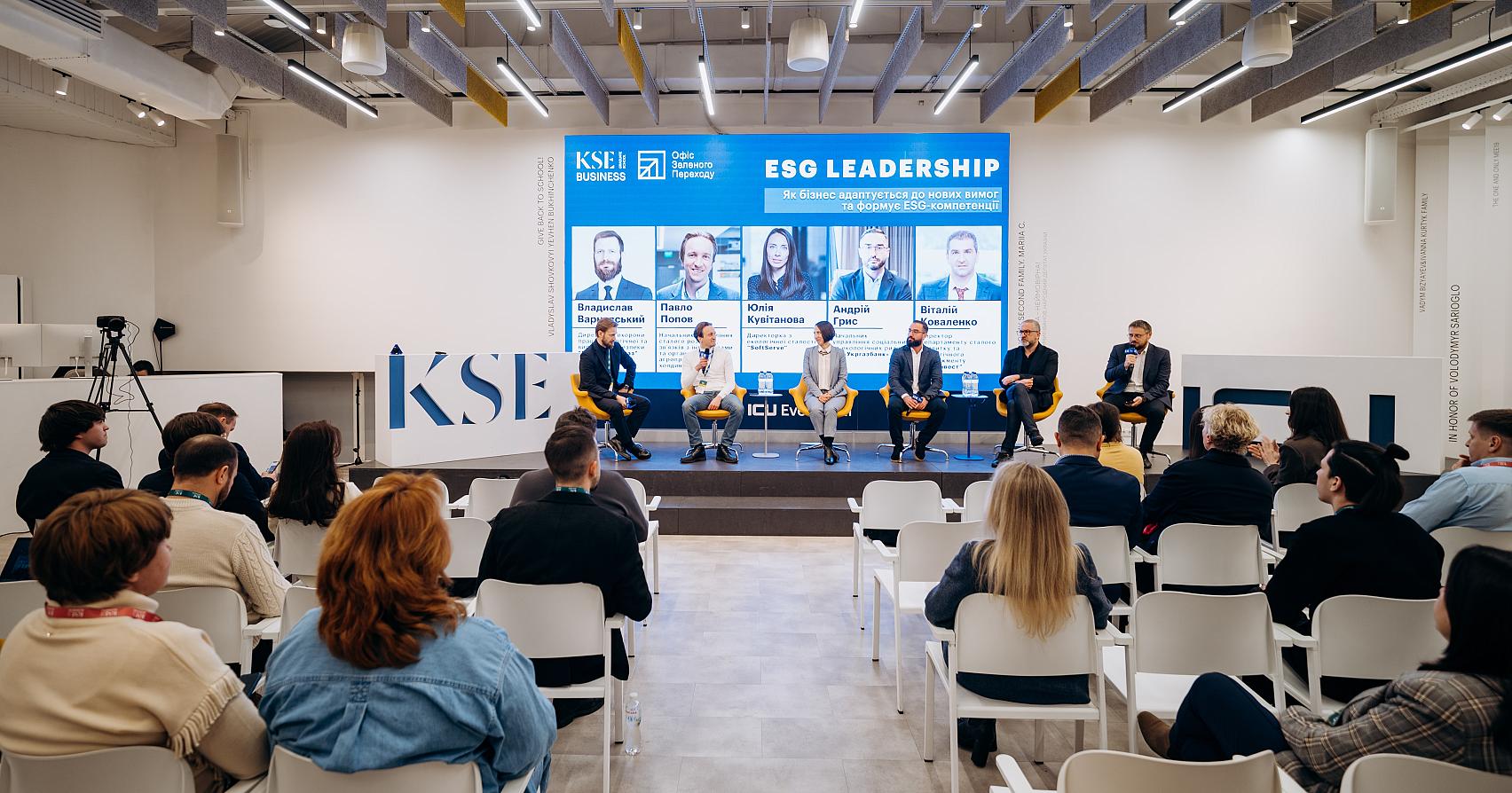
On December 10, Kyiv School of Economics, together with Ukraine's Green Transition Office, held an open presentation of the certification program "ESG Leadership: Strategy, Ethics, Impact" – a tool designed to bridge the critical gap between business demand for ESG expertise and its shortage in the market.
Andrii Kitura, Head of Ukraine's Green Transition Office, opened the presentation with research findings from 420 Ukrainian companies: "We discovered a paradox. 77% of companies say the biggest obstacle to ESG implementation is the lack of qualified personnel. At the same time, 87% of businesses are ready to implement standards but don't know where to start. This gap between readiness and capabilities is the challenge we need to address together with KSE."
Companies already need people who can attract international financing by demonstrating working ESG systems, bring products to European markets with mandatory compliance, and build climate risk management systems. But such specialists are critically scarce in the market – and this is not just a staffing deficit, it's a barrier to growth.
Oleksii Yatsiuk, Head of ESG at Ukraine's Green Transition Office, detailed the scale of the need: "71% of companies complain about the lack of accessible information on implementing standards. 75% don't understand the legislation – neither Ukrainian nor European. But the biggest problem is people. 77% of Ukrainian companies consider the shortage of qualified personnel the greatest obstacle to implementing ESG approaches."
Mykhailo Shneider, CEO of KSE, emphasizes: "At KSE, we fundamentally launch educational projects only in partnership with those who work deeply in the subject. It's important for us to be relevant to today's challenges, so all new programs are born from real business and societal demand – designed so that learning is fast, effective, and truly useful for participants. That's why in this program we combine KSE's academic expertise with the practical experience of Ukraine's Green Transition Office and focus on real business challenges."
"ESG Leadership: Strategy, Ethics, Impact" is 4 months of systematic work covering the entire ESG integration cycle: from embedding sustainable development principles into business strategy to preparing reporting in accordance with ESRS requirements.
The program is designed to prepare specialists in three key profiles that the market needs today: ESG managers for large companies capable of building internal management systems; consultants for small and medium-sized businesses that don't always have resources for in-house specialists; and independent experts who can work on multiple projects simultaneously.
Currently, Ukraine's ESG consulting market remains fragmented: international players are often financially inaccessible, while local specialists don't always have sufficient training. The "ESG Leadership" program aims to systematically fill this gap by building practically oriented expertise within the country.
Over the next 10 years, Ukraine will undergo a transformation that took decades in developed economies: the transition from businesses built around 1990s founders to companies with professional corporate governance. ESG will become a central element of this transformation, as the new generation of owners, investors, and employees won't accept different rules of the game. That's why the question is no longer about ESG's relevance, but about business readiness for these changes. Will you manage to prepare before it's too late?
Detailed information about the program, modules, and participation conditions is available at: https://forms.zohopublic.eu/ssokseorgua/form/ESGLeadership/formperma/guQwKKLUT8SJIbc4E_GLQ8GaU0lodeZ757oErS0Zv38
The recording of the program presentation can be viewed below.
The "ESG Leadership: Strategy, Ethics, Impact" program is implemented in partnership between Ukraine's Green Transition Office and KSE Graduate Business School. Ukraine's Green Transition Office provides expert support for the program, industry expertise, and understanding of current ESG transformation challenges in Ukraine. KSE Graduate Business School is responsible for academic standards, teaching methodology, program accreditation, and its organizational and financial implementation.
Published on