ESG moves beyond compliance: what investors expect from business after the regulatory reset
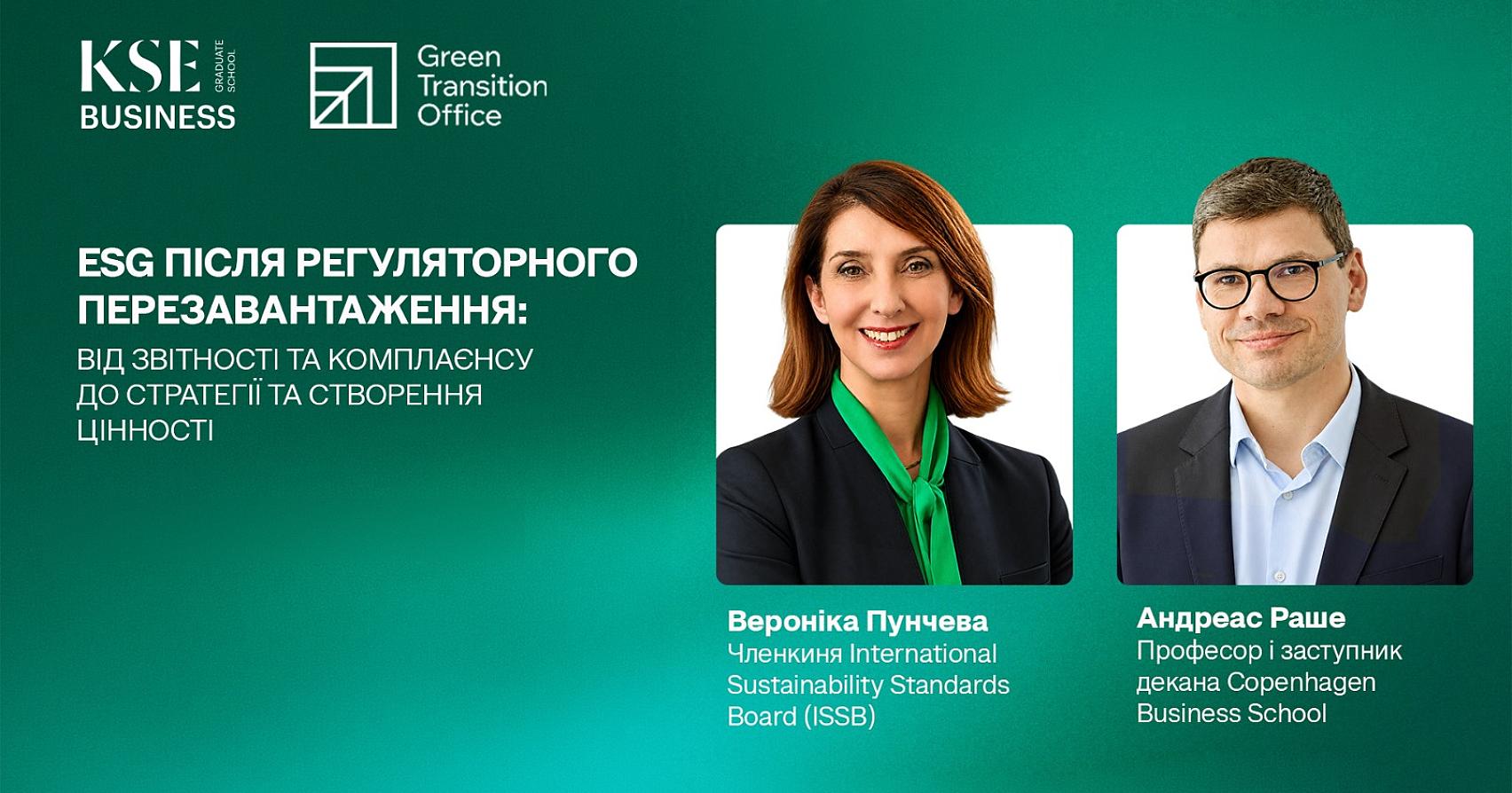
The webinar "ESG after the regulatory reset: from reporting and compliance to strategy and value creation" looked at how European sustainability regulation is changing after the wave of simplification, and what investors still expect from companies.
The event was part of the "ESG Leadership: Strategy, Ethics, Impact" programme, which the Green Transition Office runs jointly with KSE Business School.
The speakers were Andreas Rasche, Professor and Associate Dean at Copenhagen Business School, and Veronika Pountcheva, member of the International Sustainability Standards Board (ISSB). Oleksiy Yatsyuk, Head of ESG at the Green Transition Office, moderated.
The European Green Deal is changing its tools, not its goal
The European Green Deal, presented by the European Commission in 2019, still aims to make the EU climate neutral by 2050.
For all the talk of the course being watered down, Andreas Rasche argued, its underlying objectives have not moved. What has changed is how the European Union plans to finance the green transition and how it explains it.
The Green Deal leaned heavily on private capital from the start. Rasche cited estimates putting the annual funding need at some 350 billion euros, a figure governments admitted they could not cover alone. That is where the demand for transparent, comparable data came from, since investors need it to steer capital into the sectors that have to transform.
Mandatory reporting is narrowing, voluntary reporting is gaining weight
The most visible change has been the sharp narrowing of the Corporate Sustainability Reporting Directive. Rasche and his colleagues calculate that the original CSRD was meant to cover about 46,000 European companies. After the revision under the Omnibus I package, some 4,800 remain in scope, fewer even than the 11,700 or so covered by the earlier Non-Financial Reporting Directive.
The updated European Sustainability Reporting Standards also carry 61% fewer mandatory data points, with the voluntary ones dropped entirely.
"Simplification always has to be seen in context. Sustainability is much more than disclosure. I would rather see a company with realistic targets than a company with completely unrealistic targets it will never reach anyway. Much of what has happened over the past two years has been a move towards greater realism rather than a serious rollback," Rasche said.
As the mandatory perimeter shrinks, voluntary disclosure counts for more. Rasche pointed to Danish family-owned companies, where formally falling under the directive may weigh less than what partners and investors expect, or what the owners themselves value. Companies below the thresholds increasingly keep applying the ESRS voluntarily, or turn to the simplified voluntary standard for small and medium-sized enterprises.
Sustainability is increasingly explained through resilience and independence
The language of the European policy debate is shifting too. Sustainable development is giving way to economic resilience, competitiveness and energy independence.
The reasons behind this are material. Rasche presented figures showing that the European Union imports around 58% of the energy it needs, that the United States supplies roughly 45% of its imported liquefied natural gas, and that much of the world's renewable energy manufacturing capacity sits in China.
The proposed Industrial Accelerator Act and the coming Circular Economy Act are being built around the same logic of competitiveness, supply chain resilience and fewer external dependencies.
ISSB standards are spreading worldwide
Veronika Pountcheva gave the global view on sustainability reporting. The ISSB has worked within the IFRS Foundation since 2021, when its creation was announced at the COP26 climate conference in Glasgow, and published the IFRS S1 and S2 standards in June 2023.
Figures presented during the webinar put the number of jurisdictions already using the ISSB standards or moving towards them at more than 45. Between them they account for about 60% of global GDP, over 40% of global market capitalisation and close to 60% of the world's greenhouse gas emissions. The Board is also developing further disclosure requirements on nature and biodiversity risks and opportunities.
The language business uses to explain itself to investors has already changed, Pountcheva said. The discussion is moving away from individual environmental, social and governance indicators towards the resilience of the business model and a company's ability to create value over the long term.
"Sustainability risks are financial risks. To anyone who doubts whether this is still relevant, I say you don't have to believe it, it's enough to observe. No business model will finance this transition on its own. You need investors, and if you want them to come with you, you have to be able to speak that language," Pountcheva said.
How reporting should account for the war and operations in an aggressor state
The Ukrainian audience asked why European rules still set no separate requirements for operations in conflict-affected and high-risk areas, when Ukrainian businesses and investments are already deeply woven into European supply chains.
Rasche acknowledged the gap, and said it reaches beyond EU legislation, because the UN Guiding Principles on Business and Human Rights offer no clear practical guidance on this either.
He does not expect another revision of the Corporate Sustainability Due Diligence Directive (CSDDD) before 2029, which leaves companies to look to what the international business and human rights community has developed.
Participants also raised a possible blind spot in the investor approach. A company can post acceptable ESG indicators while continuing to operate in an aggressor state or materially support its economy.
Pountcheva explained that IFRS S1 already allows such situations to be captured. Significant operations or revenues in an aggressor state can create sanctions, reputational and geopolitical risks, which makes them material information for investors.
A separate mandatory requirement would be another matter. It would oblige the ISSB to define what counts as an aggressor state and as material support for aggression, and that lies outside the Board's mandate.
What this means for Ukrainian companies
The draft ESRS 40a, the reporting standard for certain non-EU undertakings caught by the relevant CSRD requirements, will matter in practice for Ukrainian business.
The Green Transition Office plans to analyse the standard separately and prepare guidance for Ukrainian companies. Rasche advised against firm conclusions while work on the document continues, since important provisions can still change at the final stages.
On 9 September the European Commission published its proposal for a new Public Procurement Act. It moves away from the dominance of the lowest price towards value for money, with environmental and climate criteria, supply chain resilience and innovation among the quality characteristics proposed for assessment.
Public procurement in the EU runs to about 2.5 trillion euros a year, close to 15% of the Union's GDP. Using it as an instrument of green and industrial policy could reshape what suppliers are asked to deliver.
Over time, and particularly as European integration advances, these approaches may also shape Ukraine's own procurement system.
Both speakers arrived at the same conclusion. The volume of mandatory requirements is no longer a useful guide: fewer companies now report by law, yet supply chain partners, investors and public procurement authorities are still asking the same questions. For Ukrainian business, embedded in European supply chains and preparing for EU accession, the task is to be ready for a conversation that treats sustainability in the language of risk, value and access to capital, rather than for any one directive.
The Green Transition Office is an independent advisory body under the Ministry of Economy of Ukraine that helps to implement reforms in the field of green transition, energy and climate policy of Ukraine. The Green Transition Office operates with the financial support of the UK International Development and is implemented by Dixi Group.
Published on