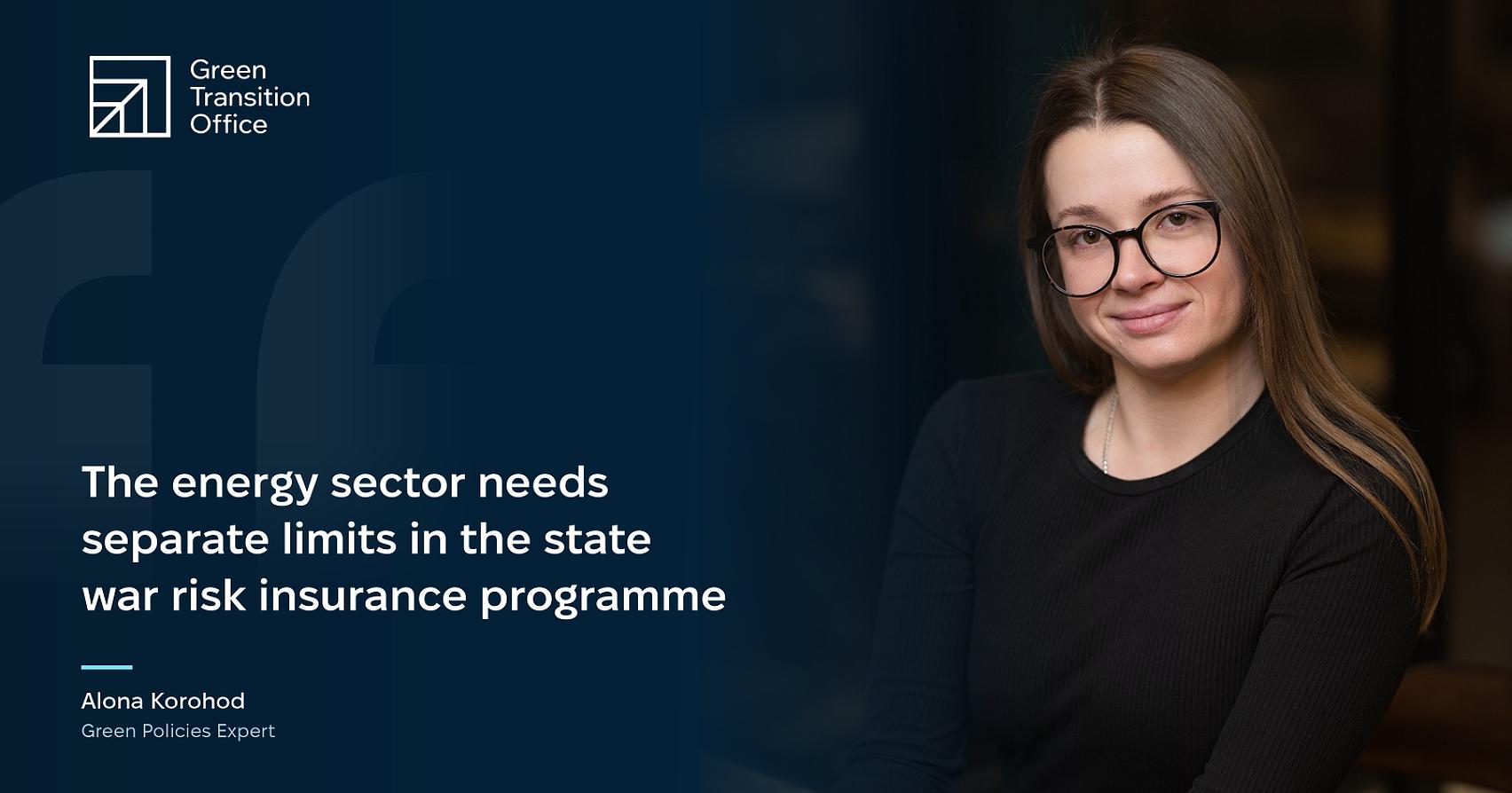
Energy needs its own limits in Ukraine's war risk insurance scheme
The state scheme reimbursing the cost of war risk insurance took effect at the start of 2026, and the first reimbursements have now been paid. Demand is climbing, but the scheme was built as a universal instrument for business as a whole, and that design leaves the energy sector poorly served.
The first six months
According to the Ministry of Economy and Environment of Ukraine, as of July 2026 businesses had received approval for 139 applications concerning damaged or destroyed property and had submitted 63 applications for reimbursement of insurance premiums. Those applications carry a total insurance coverage of UAH 7.9 billion and a potential state reimbursement of UAH 94.22 million. In May the first four companies received reimbursements worth UAH 6.8 million, and their average insurance cost fell from 4.24% to 1.19%. Over four months the number of premium reimbursement applications tripled, from 21 at the end of March to 63 in July.
No sectoral breakdown showing how many applications came from energy companies is publicly available.
Where the scheme falls short for energy
Energy infrastructure remains one of the primary targets of Russian attacks, and individual generation facilities, grid equipment or new investment projects are worth hundreds of millions or billions of hryvnias.
"For the energy sector, war risk insurance is not only a matter of compensating possible physical damage, it is also one of the preconditions for attracting new private and debt financing," says Alona Korohod, Green Policies Expert at the Green Transition Office.
An investor or a bank financing the construction of an energy facility in Ukraine has to account for the risk that it will be damaged or destroyed in hostilities. Without adequate cover, that risk drives up the cost of capital, and sometimes kills the investment case outright.
What should change
Reimbursement ceilings are the first thing to look at. The maximum reimbursement of an insurance premium currently stands at UAH 3 million per business entity per calendar year, with the state covering the share of the insurance cost above a 1% rate. That makes a real difference to a small or medium-sized business, but against a large generation facility, an energy storage system or a substation it covers a fraction of the premium. Energy needs higher limits of its own, or a ceiling tied to the sum insured or to the size of the investment.
A dedicated mechanism for strategic energy investments would address the next layer of the problem, covering new distributed generation, renewables, gas generation and energy storage systems. For such assets war risk insurance effectively becomes part of a project's bankability, because without adequate risk coverage an investor finds it harder to raise bank financing, and a lender finds it harder to agree to fund an asset in a country at war.
Ukraine's budget cannot absorb the full scale of war risks attached to large energy assets on its own. The state scheme could act as a first layer of coverage, with larger risks passing to international insurers and reinsurers and to international financial institutions. That model would raise the available limits without requiring the entire potential loss to be covered from the budget.
New capacity is a separate case. Insurance protects what already exists, but it also determines whether new energy capacity gets built in Ukraine at all.
"For new projects that strengthen the resilience of the power system, it would be worth providing a longer horizon of support and the option to obtain preliminary confirmation that insurance coverage is available already at the stage of structuring the financing," Alona Korohod explains.
What expansion would deliver
Expanding the scheme would most likely bring higher demand from energy companies, particularly if it is adapted beyond the needs of small and medium-sized businesses. Higher limits for capital-intensive projects, broader cover and access to international reinsurance would make it far more attractive to companies investing in new generation, renewables, energy storage systems and other energy infrastructure. The pay-off would work in two directions, with more energy assets insured and a better chance of unlocking private investment in the sector.
The Green Transition Office is an independent advisory body under the Ministry of Economy and Environment of Ukraine that helps to implement reforms in the field of green transition, energy and climate policy of Ukraine. The Green Transition Office operates with the financial support of the UK Agency for International Development and is implemented by DiXi Group.
Published on