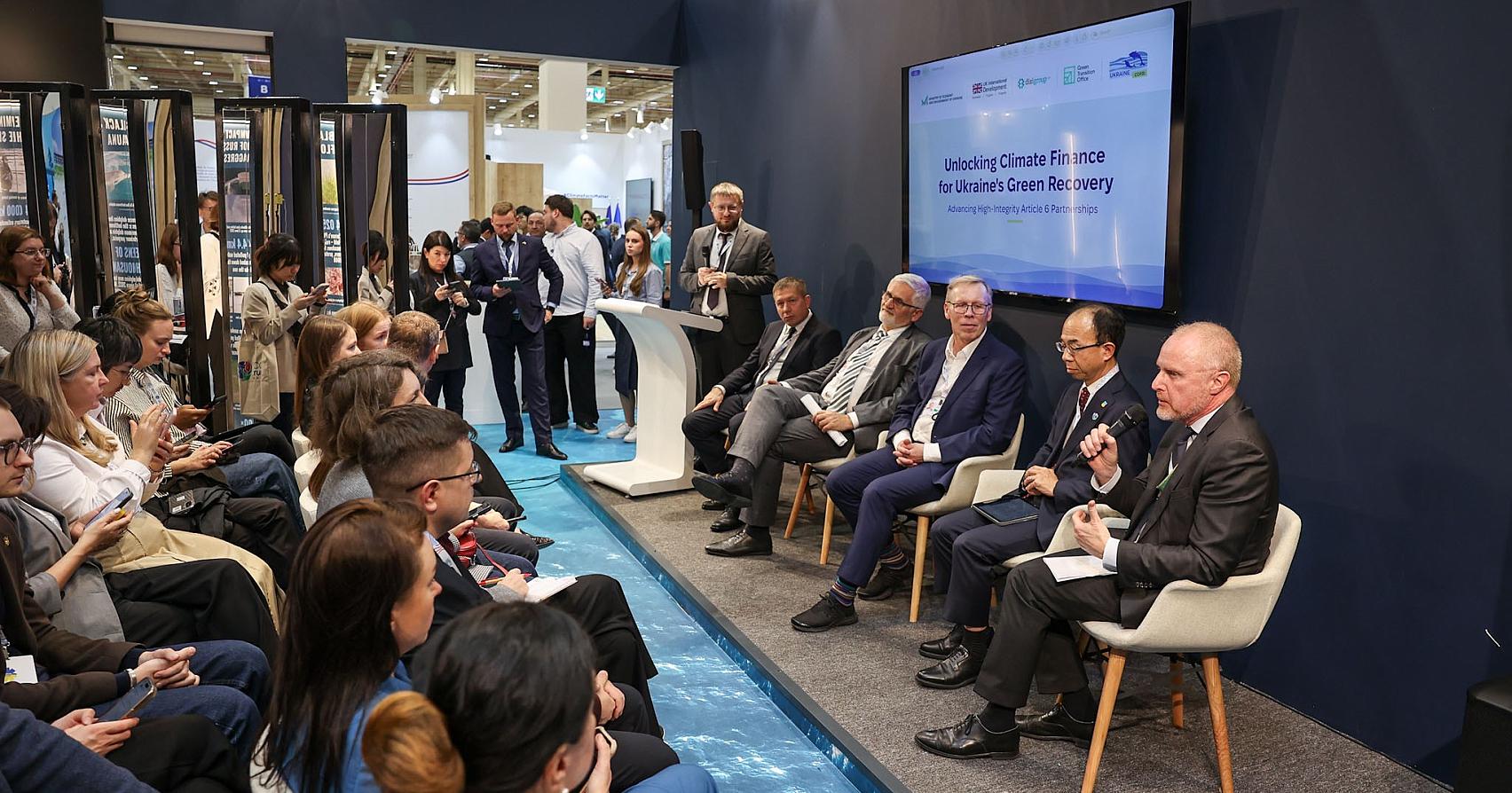
Perspectives of Article 6 projects in Ukraine were discussed at COP31 at Ukraine Pavilion
The Ministry of Economy and Environment of Ukraine in cooperation with the Green Transition Office organized a high-level event dedicated to Article 6 of the Paris Agreement and carbon markets.
On 13 November, Andriy Kitura moderated an event “Unlocking Climate Finance for Ukraine’s Green Recovery: Advancing High-Integrity Article 6 Partnerships”, during which the Ministry of Economy and Environment of Ukraine and Nefco signed a Memorandum of Understanding on cooperation in carbon markets. The memorandum sets out cooperation under Article 6 of the Paris Agreement and on voluntary carbon markets to help mobilise finance for Ukraine’s green recovery.
The Green Transition Office will act as the Ministry's focal point for the Memorandum, linking mitigation project identification with ongoing work on sectoral decarbonisation studies and the national carbon budget framework. GTO will work with Nefco to identify and assess potential projects (methane abatement, waste management, biomethane production, renewable energy and power storage, heat pumps etc.) and explore where carbon finance could complement grants and loans.
In June 2026, the Government launched a two-year experimental phase for the authorisation and transfer of mitigation outcomes and set the rules for the National Carbon Registry, building on Ukraine's existing cooperation with Switzerland and Japan. For Ukraine, Article 6 is not only a means of fulfilling international climate commitments, but also a component of post-war recovery, industrial modernisation, the development of renewable energy, nature-based solutions and strengthened energy security on the path towards climate neutrality by 2050.
The panelists examined how Ukraine could broaden its partnerships while protecting its ability to meet its own nationally determined contribution (NDC).
The event included two sub-panels with the discussion of the overall priorities in carbon market development in Ukraine and more specific discussion of potential Article 6 projects in Ukraine.
Speakers of the first panel included Deputy Minister of Economy and Environment of Ukraine Oleksandr Krasnolutskyi, Trond Moe (Managing Director of Nefco), Mattias Frumerie (Sweden’s Climate Ambassador and Head of Delegation to the UNFCCC), Jan Dusík (Deputy Director-General of DG CLIMA, European Commission) and Takeshi Sekiya (Vice-Minister for Global Environmental Affairs at the Ministry of the Environment of Japan).
“The motto of our pavilion says “Ukraine is a solution” and it actually shows that Ukraine is moving towards its goals. We understand that we need to rebuild our country but we also understand that reconstruction has to follow new technologies and new standards to achieve our goal of climate neutrality by 2050. We will need large scale investments in order to achieve our goals and consider Article 6 as one of the instruments to attract climate finance”, - commented Oleksandr Krasnolutskyi during his opening remarks.
Representatives from Sweden, Japan, and the European Commission reaffirmed their commitments to Ukraine and emphasized the importance of high-integrity carbon projects and aligning Ukraine's climate policies with EU standards.
Speakers of the second panel included Monika Figaj (Energy Community Secretariat), Natalie Bertsch (Federal Office for the Environment of Switzerland (FOEN)), Julia Shevchuk (Nefco), Andriy Hunko (GIZ), Oleg Kirichuk (UNDP) and Mykola Shlapak (Green Transition Office).
Panelists explored how to turn policy frameworks into projects that can attract finance and deliver measurable results.
Mykola Shlapak, Climate Change and Climate Policy Expert at the Green Transition Office, highlighted the links between GTO’s work on carbon budget, sectoral decarbonization studies and screening of investment projects and Article 6 mechanisms. The sectoral studies can help identify cost-effective mitigation options, while the carbon budget framework can help assess which reductions Ukraine needs to meet its own NDC and where international transfers could support additional mitigation.
“The Green Transition Office in cooperation with Nefco and the Ministry of Economy and Environment of Ukraine will select several project types and specific projects within them and will conduct their detailed analysis. We’ll test which methodologies apply, establish credible baselines, assess additionality and map the steps from project preparation through monitoring and authorisation,” – commented Mykola Shlapak.
Recording: https://www.youtube.com/watch?v=rLAlzoBItrk
The Green Transition Office is an independent advisory body under the Ministry of Economy and Environment of Ukraine that helps to implement reforms in the field of green transition, energy and climate policy of Ukraine. The Green Transition Office operates with the financial support of the UK International Development and is implemented by Dixi Group.
Photo: Joel Sheakowski for Nefco
Published on