ESG reporting software market grows 17–21% a year as Ukraine prepares digital disclosure rules
Ukrainian companies already file their IFRS financial statements electronically under an XBRL taxonomy, and a Ministry of Finance bill would extend the same approach to sustainability reporting. Draft law No. 15538, approved by the government on 20 August 2026 and submitted to the Verkhovna Rada, would require enterprises with a turnover above EUR 450 million and more than 1,000 employees to report under the ESRS in electronic format from 2028, provided parliament adopts it.
The global market for ESG reporting software is worth USD 1.1–1.3 billion and is growing by 17–21% a year, according to commercial estimates, with prices varying widely. Calculating emissions through the IBM Envizi API costs USD 45 a month on the basic plan, while the Premium tier of Microsoft Sustainability Manager runs to USD 12,000 a month, though both figures are indicative and depend on functionality.
Demand is no longer confined to large companies covered by the CSRD, as their suppliers are increasingly being asked for ESG data, and the EU has adopted a voluntary standard based on the VSME to set limits on such requests. Clients are looking for tools to collect ESG data, calculate emissions and prepare reports, as well as supplier portals and XBRL conversion with validation. Skills are also scarce, with LinkedIn data showing that demand for workers with green skills rose by 7.7% in 2025 while their number grew by only 4.3%, and that the share of such hires is rising fastest in the technology sector.
For IT teams, uploading documents, running calculations and building dashboards is familiar territory, so the harder part tends to be methodology. Developers of emissions accounting products need to master the GHG Protocol’s 15 categories of indirect Scope 3 emissions, keep up with annual updates to emission factors and build in an audit trail, without which a calculation will not survive external verification. Teams should also decide from the outset which tasks can be left to artificial intelligence without expert review, or they risk being unable to scope the work properly and justify their choices to clients.
EFRAG’s open tools can lower the barrier to entry. Its VSME Digital Template is designed for companies with up to 1,000 employees, while its XBRL converter is open source under the MIT licence and can be embedded in a company’s own product. EFRAG plans to update these materials by the end of the year, following the adoption of the EU Voluntary Standard on 3 July 2026.
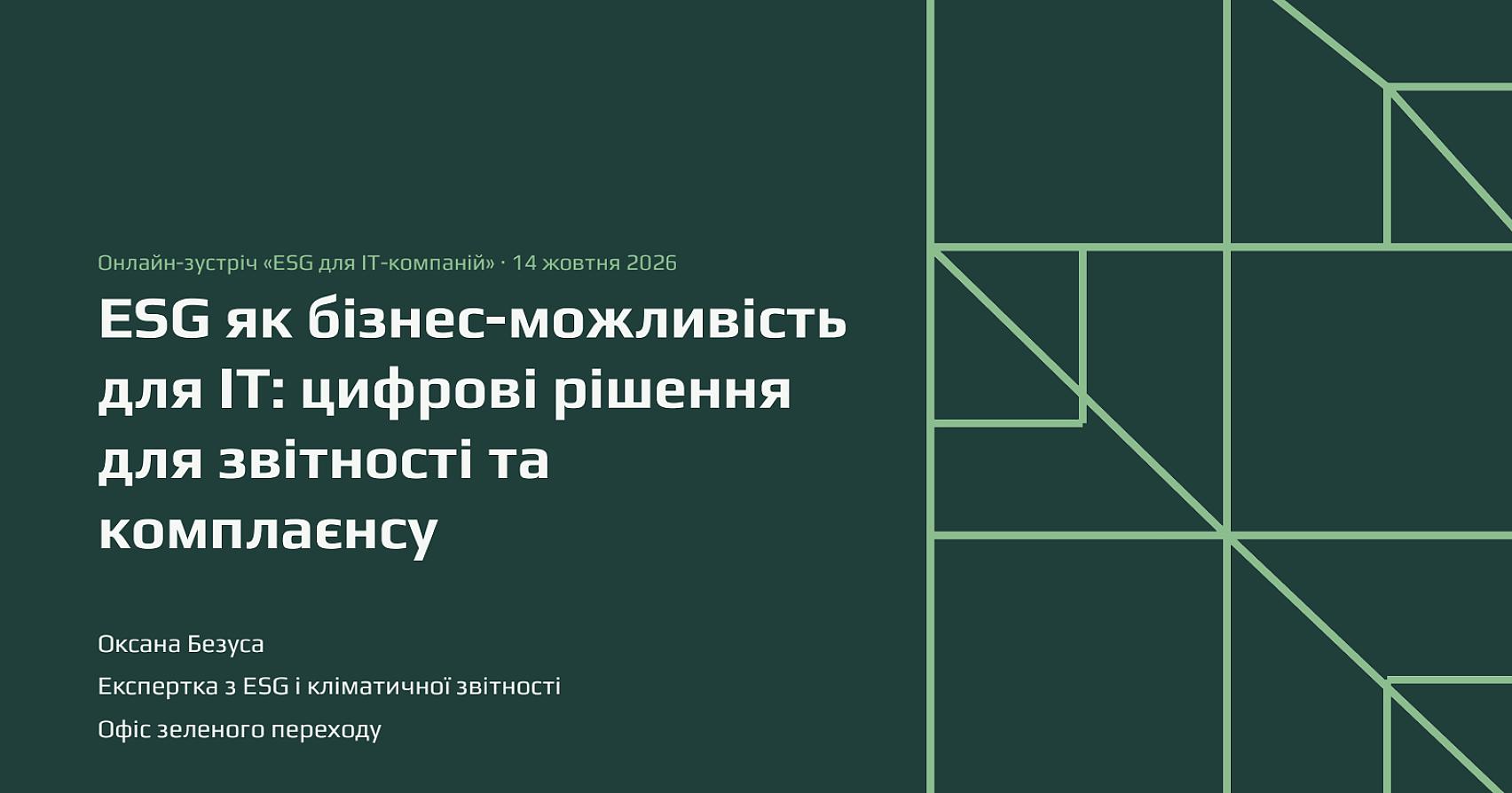
The opportunities were outlined by Oksana Bezusa, ESG and Climate Reporting Expert at the Green Transition Office, at the online meeting “ESG for IT Companies”, hosted by the Green Transition Office, KSE Business School and Diia.City Union. Bezusa has spent five years in IT, two of them working on ESG reporting software. The methodological grounding for such products is covered by the certification programme “ESG Leadership and Sustainable Impact”, which the Green Transition Office runs jointly with KSE Business School.
Oksana Bezusa’s full talk is available in the recording of the meeting https://www.youtube.com/watch?v=bSmtu3RsZeg, and her presentation can be found in the folder with the meeting materials https://drive.google.com/drive/folders/1GzV4MyRc8g2xab8L-PgTCb1W2Rz8MXyn?usp=sharing
Published on