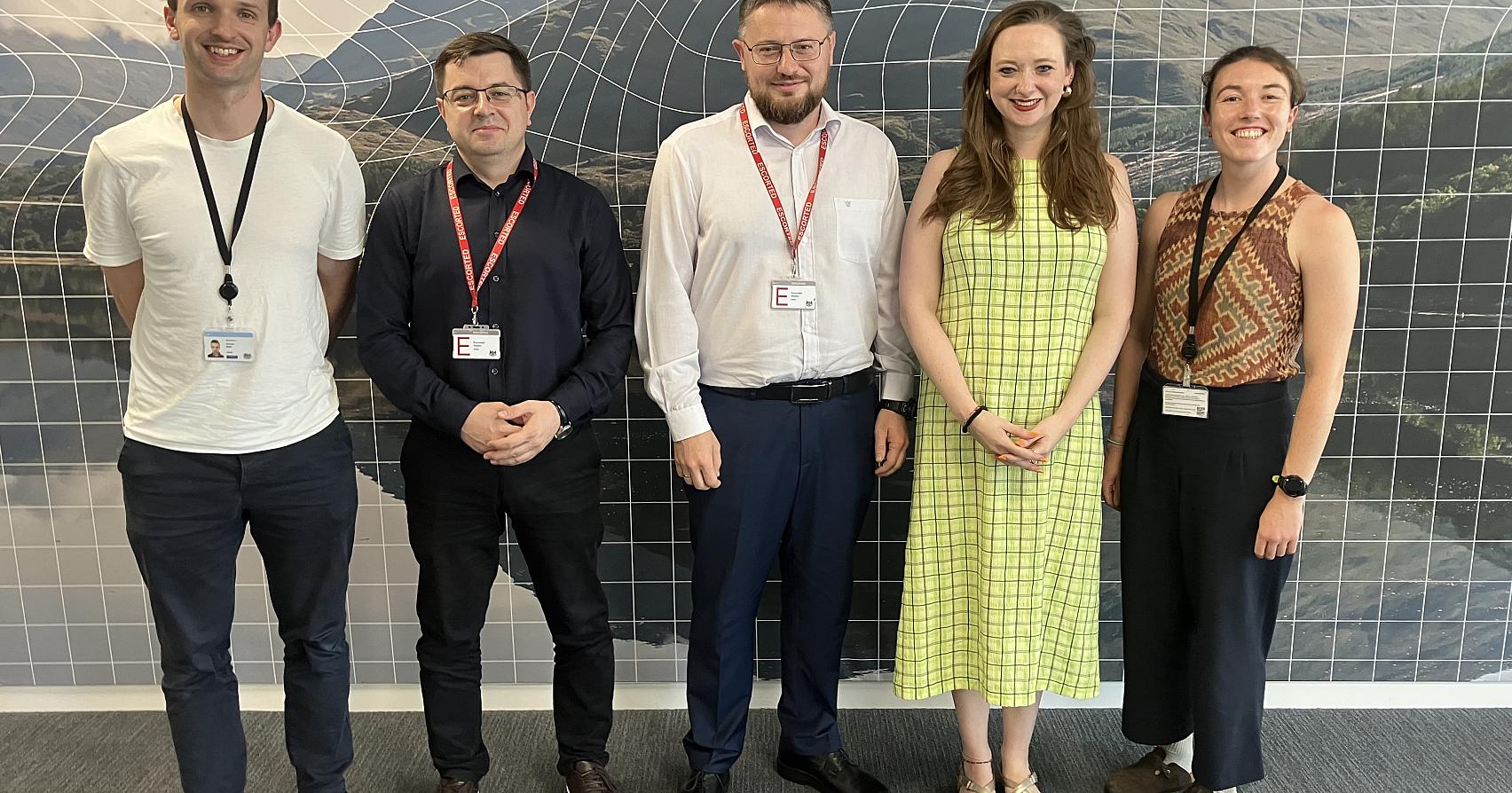
UK CCC Provides Capacity-Building Support to the Green Transition Office
During the London Climate Action Week, the UK Climate Change Committee (hereafter – UK CCC) welcomed representatives of the Green Transition Office for a two-day capacity-building session. The members of the GTO participated in a series of meetings dedicated to carbon budget development, climate policy monitoring and climate governance more broadly, coordinated by Blánaid Sheeran, International Engagement Lead at the UK CCC.
The UK Climate Change Committee was established under the Climate Change Act 2008 and provides independent advice to the UK Government on reducing emissions and adapting to the impacts of climate change. In particular, the UK CCC advises on carbon budgets that show a cap of greenhouse gases emissions over five-years periods and on climate risks the UK is facing, as well as provides regular reports on progress in reducing emissions and adapting to climate change impacts.
Over the past year the Green Transition Office benefited from the support from the UK CCC within the mentorship program coordinated by the Secretariat of the International Climate Council Network. The two-days capacity building session expanded this cooperation and capacity building support provided by the UK CCC.
GTO members had a meeting with Emma Pinchbeck, CEO of the UK Climate Change Committee, where they discussed organizational and governance aspects related to the work of climate councils and the role of the secretariats in providing science-based policy advice. In-depth discussion during the meeting allowed to deepen the understanding of the Climate Change Committee work and the knowledge gained will be used in providing advice on the development of national climate governance system in Ukraine, including the operationalization of the Scientific and Expert Council on Climate Change and Preservation of the Ozone Layer.
Andriy Kitura, head of the Green Transition Office, presented the results of sectoral decarbonisations studies conducted and being under development, as well as the concept of national carbon budget development for Ukraine, including key challenges in designing sectoral pathways, building decarbonisation scenarios, modelling and data availability.
After that, members of the GTO and UK CCC held in-depth discussions regarding key aspects of climate council mandates and procedures with practical implication in the UK and Ukraine.
Dr Eoin Devane, Director of Net Zero at the UK Climate Change Committee, presented UK carbon budget development process and the UK CCC work on designing an ambitious, evidence-based deliverable pathway to net zero. GTO experts had an opportunity to discuss specific questions related to carbon budget development, including estimation of cost-effectiveness of different decarbonisation measures, definition of technology adoption rates and linkages of sectoral pathways with specific business cases.
Rachel Hay, Head of Energy Supply Decarbonisation and Resilience, introduced the approach that the UK CCC applies for monitoring progress in climate policy implementation, including emissions analysis, indicators analysis and policy assessment. In-depth and granular analysis allows regular assessment of whether implemented policies are sufficient to reach the carbon budget. GTO will use the knowledge gained in the further development of climate policy monitoring framework based on the already ongoing work on National Energy and Climate Plan implementation and progress reporting.
Bea Natzler, Team Leader of the People and Business Team of the UK CCC and other members of the team introduced the approach for economic analysis of the net-zero pathway and key policy messages related to the impact of a balanced pathway to net zero on businesses and households. Joshua Deru, Just Transition Lead at the UK CCC, focused special attention on aspects related to just transition, including impacts on jobs and skills demand, as well as household expenses. Experts highlighted the importance of policy design to provide targeted support for the industries and regions that would be affected by the net-zero transition but also policies that would accelerate the development of industries that will benefit from the decarbonisation pathway. The GTO team benefited from the discussions of the approaches on assessing the impacts of climate policies on specific industries and on households, as well as skills gaps identification and closure.
Dr Richard Millar, Director of Adaptation at the Climate Change Committee, alongside Director of External Affairs Sophie Vipond, introduced the key findings of the recent A Well-Adapted UK report. This report forms part of the fourth independent assessment of UK climate risks and offer solutions to adaptation planning. One of the key messages of the report is that, at a minimum, the UK should prepare for the future climate with global warming levels reaching 2°C above pre-industrial levels by 2050 and plan its development considering relevant climate risks and adaptation measures. Among other topics the UK CCC team provided additional insights on climate risks assessment process and highlighted the focus on solutions that should be implemented now to be well-prepared and well-adapted to future climate conditions. GTO members discussed assessment of economic benefits of joint climate mitigation and adaptation activities, as well as approaches for the integration of climate adaptation into the decision-making process, including sectoral strategies, appraisal of public investments and review of construction standards.
Green Transition Office is grateful to UK CCC experts for the insightful and productive capacity building session and will use the knowledge gained for further enhancement of climate governance system in Ukraine and providing science-based and data-driven advisory support to the Government of Ukraine.
Published on